

The government has published its long awaited small business plan, which outlines how it will support the UK’s small and medium sized businesses.
In a joint forward, chancellor Rachel Reeves and business secretary Jonathan Reynolds say the aim is to “make the UK the best place to start and grow a business, with a culture that supports businesses in every community and high street”.
They add that the government “is determined to remove the barriers that have held back Britain’s risk-takers for too long”, and to “breathe new life into our high streets, support traders, those just starting out, and businesses that are ready to take the next step and grow”.
The government claims that by accelerating the growth of SMEs by just one percentage point a year could deliver £320 billion to the UK economy by 2030.
Entitled ‘Backing Your Business’, the document is focused on five key themes:
- Fixing the fundamentals through tackling late payment, modernising the tax and customs system to make it easier to navigate, and reducing regulatory burdens
- Unlocking access to finance through the British Business Bank
- Backing the “everyday economy” by “revitalising high streets, supporting local enterprise and tackling crimes like tool theft and shoplifting that hurt small businesses”.
- Future-proofing business skills such as digital technology, AI, leadership and management.
- Opening up opportunities through international trade and winning government contracts.
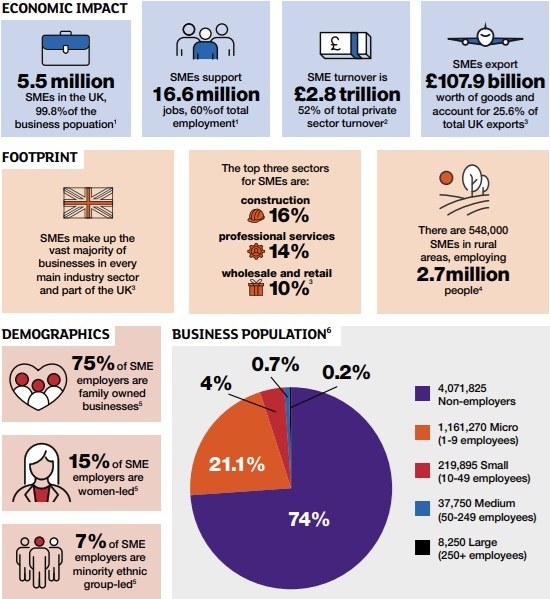
For context, the government published this graphic about the UK’s small business landscape.
Here are the key points in the plan:
Late payment
The government says it will “legislate to end the scourge of late payments which costs the UK economy almost £11bn per year and closes down 38 UK businesses every day“. The plan describes the changes as the “most significant legislation to tackle late payments in over 25 years” which will “give the UK the strongest legal framework on late payments in the G7”.
The government will legislate to require large companies to include their payment performance within their annual reports with the aim of “increasing transparency and provide greater oversight of payment performance reporting at board level, including by audit committees where they exist”.
For other measures a consultation has launched. It is open for responses until 23 October 2025. The measures are:
- The Small Business Commissioner (SBC) will be given the power to issue financial penalties to big businesses who persistently pay their suppliers late. Penalties will be based on businesses’ unpaid statutory interest liability.
- Other new powers include improving the SBC’s ability to conduct investigations into poor B2B payment behaviour, provide legally binding arbitration in disputes, and impose financial penalties or make arbitration awards after an investigation or arbitration process. The SBC would also be able to investigate the accuracy of the payment reporting data that large businesses provide under The Reporting on Payment Practices and Performance Regulations 2017.
- Maximum payment terms of 60 days, reducing to 45 days after five years.
- A 30-day invoice verification period which means businesses who want to raise a dispute will need to do so within 30 days of receiving an invoice, otherwise they will be liable to pay the invoice in full within the agreed payment terms, alongside any statutory interest or debt recovery costs if the invoice is paid late.
- Statutory interest rate payable on B2B late payments will be made mandatory.
- Prohibit the use of retention clauses in construction contracts.
Access to finance
As previously announced, to improve small businesses’ access to finance the government will increase the total financial capacity of the British Business Bank to £25.6 billion.
The small business plan announces that the Start Up Loans scheme will be provided with £1 billion to offer 69,000 more loans with mentoring over the next four years.
The capacity of the ENABLE Guarantees programme, which is designed to encourage lending to smaller businesses, will be increased from £2bn to £5bn.
The British Business Bank’s Regional Angels Programme, which aims to help reduce regional imbalances in access to early stage equity finance for small businesses across the UK, will receive an extra £340m to benefit 800 businesses.
The Growth Guarantee Scheme has been extended to 5 April 2030.
Following concerns that funders are using personal guarantees as a substitute for proper risk assessment, the government said it will work with lenders on the appropriate use of personal guarantees, including a mandatory code of conduct for accredited lenders that use the Growth Guarantee Scheme.
As previously announced, the government will work on backing more businesses and investors from under-represented backgrounds through a new £400m Investor Pathways scheme, expanding support to diverse angel networks through new angel syndicate support and embracing diversity programmes, and by supporting the Invest in Women Taskforce.
Digital adoption and other skills
The government will launch digital adoption pilots and partner with industry to provide support and best practice on adopting technology.
The government said it will build on the work of the SME Digital Adoption Taskforce, an industry-led government advisory group.
The taskforce’s final report has been published alongside the small business plan. Recommendations include appointing a minister accountable for SME digital and AI adoption, developing an online CTO as a service to provide AI-powered guidance to SMEs, and launching an awareness programme for digital and AI adoption.
As previously announced, the Made Smarter Adoption programme will be expanded for manufacturing SMEs, and a new tech adoption scheme will be launched for high-growth potential professional and business services sector SMEs.
Leadership training will be provided by a new industry-led Business Mentoring Council.
To encourage future entrepreneurs, enterprise education and competitions will be promoted in schools, colleges and universities, and a new ‘youth entrepreneur’ category woll be added to the King’s Awards for Enterprise.
The government says it will “ensure the needs of smaller firms are met through the skills and apprenticeships system, including through £1.2 billion of additional investment per year by 2028-29, engaging with SMEs on accessing apprenticeships and T-Levels.
Shorter apprenticeships and foundation apprenticeships will be launched in August 2025, and short courses in England in areas such as digital, artificial
intelligence and engineering will be introduced from April 2026.
An employer support fund targeted at SMEs in England has been launched for 2025/2026, to support with costs associated with hosting placements for apprentices and students.
High streets
The government will introduce a new national licensing policy framework to cut the cost, complexity, and time it takes to open and operate hospitality venues. It will also establish hospitality and night-time economy zones which will fast-track permissions for alfresco dining, pubs, bars and street parties.
High street and growth incubators will be delivered through mayoral authorities in Greater Manchester, West Yorkshire and the West Midlands.
The government will continue to “champion” the high street rental auctions scheme to bring empty properties and unused space into use.
The government aims to have 350 banking hubs by the end of this Parliament.
As previously announced, funding will be provided to up to 350 deprived communities for regeneration projects.
As previously announced, the government will introduce permanently lower business rates multipliers for properties with rateable values below £500,000, starting in 2026/27.
Steps will be taken to tackle crime and anti-social behaviour that impacts on businesses, including theft of tools from vehicles.
Business Growth Service
As previously announced, a new Business Growth Service is being launched with the aim of making it easier for small business owners to find and access advice and support.
The plans says: “The Business Growth Service will be delivered in partnership with public bodies, devolved governments across the UK (including in Scotland, Wales and Northern Ireland), and the private sector. As part of this, we will seek to create a genuinely integrated approach across the business support system and public finance
institutions to support firms with what they need, when they need it, on their
growth journey.”
The Business Growth Service is integrated with a new digital service for small businesses at business.gov.uk. You can access business advice and find support schemes in your area.
Public procurement
The government has already introduced changes to help more small businesses win public sector contracts through the Procurement Act 2023 reforms. I will also launch a new SME procurement education programme on applying and winning contracts and a new consultation on further legislative procurement reform.
The Ministry of Defence is launching a new SME Defence Centre to simplify
access to defence for SMEs.
Self-employment
The plan says that the Department for Business and Trade and Department for Work and Pensions will work together to “ensure there is a stronger connection between our
business support offer and the employment support system”. The government says it will look at existing schemes for best practice, such as the Manchester EnterprisingYou scheme.
The government will review the existing offer of support for the self-employed and consider whether it should be enhanced as outlined in the Get Britain Working White Paper.
The plan also says DBT and DWP will to work on how Universal Credit supports those in self-employment and enables new businesses to succeed.
On employment and self-employment for disabled people, the plan refers to the Pathways to Work Green Paper and the consultation on the future of Access to Work.
As announced in the creative industries sector plan, the Department for Culture, Media and Sport (DCMS) will appoint a freelance champion who will work with industry to represent freelancers’ views with ministers and officials in relevant government departments.
In response to the Lilac Review, the government says it will consider the role of employers in creating accessible and inclusive workplaces as well as the future of assistive technology, and on how we can support self-employed people.
Exporting
Only 11.5% of SMEs export, compared to 40% of large businesses, so to improve that the government will integrate export support and advice into the new Business Growth Service.
The government has increased UK Export Finance (UKEF) lending capacity up to £80bn, with the aim of supporting 1,000 new SMEs by 2029. It has also launched Small Business Builder, a new export insurance product.
The government said it will continue to raise awareness of the benefits of exporting through a programme of export roadshows and the new Board of Trade.
Energy and net zero
The government will link the UK Business Climate Hub with the new Business Growth Service and local sustainability champions, as well as providing ‘green’ Start Up Loans.
The Net Zero Council will publish guidance to help sectors decarbonise later this year.
To ensure SMEs receive a higher standard of service when it comes to securing their energy contracts, the government will publish its response later this year to the consultation on introducing a regulatory regime for third-party intermediaries
such as energy brokers.
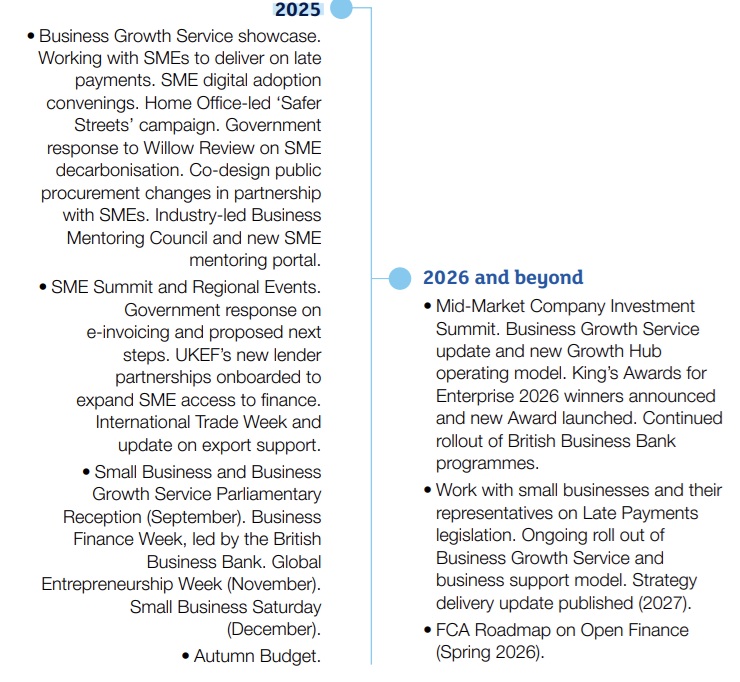
The government released this timetable for how support will be rolled out:
I’m Dan, a freelance small business journalist and event/podcast host with 20+ years of experience. If you’re looking for small business-focused content or an engaging event host, I’d love to help. Get in touch.
.
 Dan Martin